Monday, May 2, 2016

Mother's Day Gift The Gaither Homecoming Bible NKJV Hardcover


Product Description

The Gaither Homecoming Bible makes the Bible come alive for those seeking truth in the twenty-first century—even for those who think they already know it.For years, Bill and Gloria Gaither have reached millions of people across generations with the Good News of Jesus Christ. Their music of joy, thanksgiving, and praise ushers people into the presence of God so that He can do His wondrous work in their lives.  This beautiful Bible featuring the New King James Version (NKJV) is one that you will treasure for years to come.
Features include:
  • Inspirational and insightful Scripture devotions by the Gaithers and other favorite Homecoming artists
  • Articles on beloved hymns, gospel songs, and Gaither classics and the inspiration behind them
  • Original poetry by Gloria Gaither to enlighten and inspire
  • Quotes by greats of the faith, reflecting on the importance of music in the life of believers
  • Words of Jesus in red text

Product Information


Format: Hardcover
Number of Pages: 1676
Vendor: Thomas Nelson
Publication Date: 2012
Dimensions: 9.50 X 6.75 X 2.00 (inches)
ISBN: 1418549924
ISBN-13: 9781418549923
Availability: In Stock
Text Size: 11-13 Point
Text Color: Red Letter


Available at PGS Coins eBay Store:

http://www.ebay.com/itm/Gaither-Homecoming-Bible-NKJV-Hardcover-/291672058852?hash=item43e9026be4

The Best Performing Asset Class Over the Last 50 Years Is...

We  continue to see articles by so called “experts” trashing Gold and Silver as investments. Gold is everything from a “Pet Rock” to a “Dumb Investment” or “Barbarous Relic.”
Do these people even bother doing research? Or are they just stock shills?
First and foremost, you cannot compare Gold’s performance relative to stocks anywhere before 1967.
Why?
Because Gold was pegged to currencies up until that point. Any comparison of Gold’s performance relative to other asset classes prior to 1967 is completely misleading because Gold’s performance was limited by currency pegging.
However, once began to be de-pegged in 1967, the story changes.
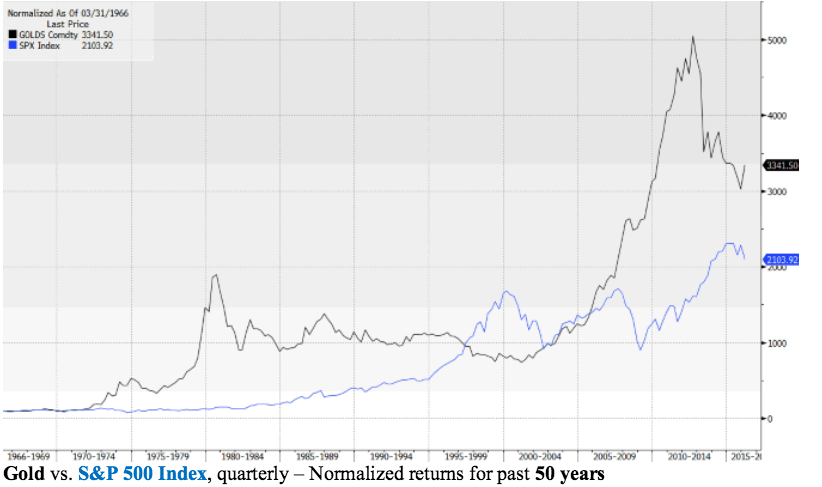
As Bill King notes, Gold’s performance has absolutely DEMOLISHED that of stocks post 1967. The below chart normalizes both asset classes.
As you can see, even with Gold having lost nearly 40% of its value since 2011, and stocks soaring to all time highs over 2,100 on the S&P 500, the comparisonisn’t even close.
GOLD67.png
-----------------------------------------------------------------------
The Single Best Options Trading Service on the Planet
 THE CRISIS TRADER has produced an astounding 366% return on invested capital thus far in 2016.
We have a success rate of 72% meaning we make money on more than seven out of 10 trades. And thanks to careful risk management we've seen triple digit returns on invested capital every year since inception.
Our next trade goes out this morning... you can get it and THREE others for just 99 cents.
To take out a $0.99, 30-day trial subscription to THE CRISIS TRADER...
-----------------------------------------------------------------------
This outperformance has continued recently despite the Fed juicing the market at every turn.
Between the year 2000 and today, stocks have been in two of the biggest stock bubbles in history. Over this time period the Fed has done almost nothing but prop stocks up by printing money or maintaining interest rates far below where they should be.
And yet, Gold has once again CRUSHED stocks’ performance. Again, the comparison isn’t even close (and that includes Gold’s terrible performance from 2011 onwards).
Gold2000.png
Despite these two facts, you rarely if ever see pro-Gold articles appear in the media.
It’s odd… for an asset class that less than 1% of investors actually own, “reporters” and “analysts” sure spend an awful lot of trashing it. How come they don’t spend an equal amount of time trashing uranium or other under-owned asset? Why spend so much time focusing on an asset that so few people even own?
Probably because:
1)   Gold doesn’t generate any revenue for financial institutions (brokers, investment managers, etc.)
2)   Gold doesn’t benefit the banks, as you can store it if your own safe.
3)   Gold and its performance run counter to the view that you can generate wealth via money printing.
At the end of the day, buying Gold represents pulling your money from the financial system… which is the last thing the Fed wants anyone to do.
Meanwhile, as Central Banks turn up the printing presses again, Gold is once again beginning to show signs of life, turning upwards against all major currencies.
gpc5216.png
We believe the next leg up is about to begin for Gold. Those who remember form the last Gold bull market in the ‘70s, it was the second leg of Gold’s bull market that saw the most gains.
From 1970 to 1974, Gold rose 550%. It then took two-year breather before beginning its second, much larger leg up. During that second leg, it rose over 900% in value.
If Gold were to stage a similar move now, it would rise to over $10,000 per ounce.
On that note…
We're currently preparing for a similar situation today.

Best Regards
Graham Summers
Chief Market Strategist
Phoenix Capital Research
Our FREE e-letter: http://gainspainscapital.com/
Follow us on Twitter: http://twitter.com/GainsPainsCapit

Mother's Day Gift Billy: The Early Years of Billy Graham, DVD


Product Description You know Billy Graham as a self-assured and charismatic preacher---and one of the most important figures of the 20th century.
 Now meet him as he was---an earnest young man struggling with faith and doubt in Depression-era America. You'll be inspired by the story of his decision for Christ... and where it led! Starring Armie Hammer, Stefanie Butler, Josh Turner, Martin Landau, and Lindsay Wagner. Dove approved. Rated PG. Approx. 98 minutes. Special Features: Behind-the-Scenes Making of Billy: The Early Years Photo Gallery Spanish Subtitles Closed Captions

Available at PGS Coins eBay Store:

Mother's Day Gift Lee Strobel The Case for Faith (DVD, 2008)


Product Description In his #1 best-seller The Case for Christ, legally trained investigative reporter Lee Strobel examines the claims of Christ, reaching the hard-won verdict that Jesus is God's unique son.
 Despite the compelling historical evidence, many people grapple with serious concerns about faith in God. "If God is love, then what about all the suffering in our world?" "If Jesus is the door to heaven, then what about the millions who have never heard of him?" In The Case for Faith, Strobel turns his tenacious investigative skills to the most persistent emotional objections to belief - the eight "heart" barriers to faith. The Case for Faith is for those who may be feeling attracted to Jesus but who are faced with intellectual barriers standing squarely in their path. For Christians, it will deepen their convictions and give them fresh confidence in discussing Christianity with their most skeptical friends.

Available at PGS Coins eBay Store:

http://www.ebay.com/itm/Lee-Strobel-Case-Faith-DVD-2008-/291672152988?hash=item43e903db9c


Sunday, May 1, 2016

Puerto Rico Says Will Default Tomorrow, Begs Congress For Help "Or Else Crisis Will Get Worse"

Update: PR Governor Padilla has spoken...
  • *PUERTO RICO GOVERNOR SAYS WON'T PAY DEBT TOMORROW
  • *PUERTO RICO GOVERNOR SAYS ISLAND WON'T PAY DEBT MONDAY
  • *PUERTO RICO GOVERNOR: GOVERNMENT SIGNED MORATORIUM BILL YESTERD
  • *PUERTO RICO NEEDS DEAL W/ CREDITORS AND/OR CONGRESS: GARCIA
And of course, demands a bailout...
  • *PUERTO RICO GOVERNOR CALLS ON U.S. CONGRESS, PAUL RYAN FOR HELP
And then threatens...
  • *CRISIS WILL GET WORSE IF U.S. CONGRESS DOESN'T HELP: GARCIA
  • *PUERTO RICO GOVERNOR CONCLUDES REMARKS TO COMMONWEALTH
As we detailed earlier, It's D-Day in Puerto Rico. As Bloomberg reports, investors are finding little comfort in the Puerto Rico Government Development Bank’s efforts to strike a last-ditch agreement with creditors to soften the blow of a default this weekend. The bonds that mature today (May 1st) havecrashed to just 20c (disastrously below the 36-cent recovery rate the commonwealth proposed in March).
 
It appears investors are not buying what Puerto Rico is selling and prefer to dump the bonds than hold out in hope of a 'deal'...
A default on the $422 million due today is "virtually certain," S&P Global Ratings said April 11.
No matter which route Puerto Rico takes, credit-rating companies see a default as inevitable. Moody’s Investors Service analysts said last week that any non-payment, even if it’s agreed to by creditors, constitutes a default in their eyes. S&P Global Ratings said a distressed-debt exchange or temporarily withholding interest is synonymous to default.
But as Bloomberg reports, Puerto Rico said its Government Development Bank, which is operating in a state of emergency to preserve its dwindling cash, reached an agreement with some credit unions to delay $33 million of bond payments as the commonwealth rushes toward a potential historic default.
The pact only affects a portion of the $422 million that the bank owes on May 1.The GDB will exchange the $33 million in bonds for new debt that will mature May 1, 2017, Governor Alejandro Garcia Padilla’s administration said in a statement Friday. The terms of the agreement are available to other credit unions, called cooperativas, and investors, according to the statement.

“Apart from this private exchange, GDB continues to negotiate a potential transaction related to an exchange of all of GDB’s bond indebtedness, which would require the participation of all creditors of GDB (including the cooperativas),” the administration said in the statement. “The private exchange does not affect, or take the place of, those ongoing negotiations.”
The bank is still negotiating a possible debt exchange on all of its bonds, which would require the participation of all its creditors, according a the statement. The GDB, which structured the island’s debt sales, has $5.1 billion of debt. The governor’s office said Garcia Padilla will speak to the commonwealth in a televised address Sunday at 5 p.m. New York time.

"Gold Isn't An Investment - Gold Is Money"

Gold isn’t an investment. Gold is money.
In this succinct interview with Casey Research Director Brian Hunt reveals some of the biggest misconceptions about gold… and why you should own it.
Casey Research: Brian, as you recall, we probably get more questions and reader feedback on gold than on any other subject here at Casey Research… And we've noticed there are quite a few myths and misconceptions about gold out there. Can you go over some of the big ones for us?
Brian Hunt: Sure. Probably the biggest misconception investors have about gold is that it's an investment.
They'll listen to people on CNBC pick apart and analyze every $30 move in the metal, just as they would talk about a move in crude oil or stocks or bonds. They'll check the price quote every day… to see how their "investment" in gold is performing.
That just isn't a useful way to view gold.
Gold isn't an investment. A thousand shares of Coca-Cola is an investment. An income-producing rental property is an investment.
Coke is a business that stands a good chance of growing its cash flows… which will allow it to pay increasing dividends to its shareholders. Bought at the right price, a rental property will return all of your original capital in the form of rent checks… and the rest is gravy.
Gold isn't like those two examples at all. Gold is money.
Gold has been used for money for thousands of years because it's easily di­visible, it's easily transportable, it has intrinsic value, it's durable, and its form is consistent around the world. And, as Doug Casey reminds us, it's a good form of money because governments can't print it up on a whim. It’s the only form of money that is not someone else’s liability.
Gold doesn't pay interest or a dividend. It doesn't have profit margins. Your gold holdings amount to lumps of metal held in storage.
The sooner investors realize that gold is money… and not a con­ventional investment, the better off they'll be. It's just a timeless form of money. That's it.
Casey Research: People can also view it as insurance, right?
Hunt: Right. Since gold is real wealth you can hold in your hand, it's also "crisis insurance"… or "wealth insurance."
Like regular insurance, you buy gold and hope you don't have to use it.
Gold is insurance against governments doing foolish things with their finances. It holds its value, while paper money does not. The value of every paper currency plummets over time. Gold doesn’t.
A currency is sort of like the share price of a country. Over time, if a country produces more than it consumes, saves money, and maintains a modest amount of debt, its cur­rency will rise.
If a country consumes more than it produces… if it spends lots of money and borrows a lot in order to do all of that spending, its currency will fall in value. While currencies fluctuate for all sorts of reasons in the short term, over the long term, countries that manage their checkbooks will enjoy strong currencies. Countries that mismanage their checkbooks see their currencies plummet.
I wish I lived in a country that produces more than it consumes… that values personal responsibility and saving money. I wish our government valued fiscal responsibility. But it doesn’t.
About half the U.S. is on the government dole in some form or an­other. More than 45 million people are on food stamps. People are being paid by the government not to work. The people employed by the govern­ment enjoy huge, outsized salaries for what they do. There are more tax recipients now than tax payers. There is no political will to rein in spending and borrowing.
This situation could easily result in a crisis. That's why I own gold… and recommend people keep at least 5% or 10% of their wealth in gold.
But here's where I differ from the average gold owner: I'd love to see gold fall down to $300 or $400 per ounce. I'd love to see the value of my crisis insurance fall, rather than skyrocket… just like I don't want my family's house to burn down… or like I don't want someone to T-bone my car in an intersection.
But when I look at the gang of clueless college professors and career politicians that occupy the White House and Congress, I’m not very optimistic.
Casey Research: We all need insurance from those people. Do you think at least large institutional investors, like mutual-fund companies, understand gold?
Hunt: Absolutely not. They are just as ignorant about gold as the average Joe on the street. They might even be worse.
From the early 1980s to 2000, nobody worried about insurance. Stocks and the economy boomed for nearly 20 years. Gold languished for a long time.
Its importance as real money – as a crisis hedge – was forgotten by most people… even by the supposedly smart folks who run big investment funds.
They learned their trade during a period of rising stock prices and falling gold prices, so they think gold is something right-wing nuts stockpile alongside canned food in a bomb shelter. It's amazing how a few decades of smooth sailing will make folks forget gold's importance as insurance against disasters.
I've heard lots of supposedly smart institutional investors pooh-pooh gold because it didn't perform well during the 1980s and 1990s. They'll post charts showing how it lagged behind stocks and real estate.
It's a silly comparison, because gold isn't an investment like stocks and real estate can be. Gold is just gold. Like I said, you own it and hope to never have to use it. You don't get it confused with a stock like Johnson & Johnson.
Casey Research: We think you've made your point. Any parting shots?
Hunt: It's tempting to make comparisons to other wild periods like the 1970s or the 1930s. But those historical comparisons aren't worth anything. And I'm going to catch hell for saying this, but they aren't worth anything because this time is different.
I know "this time is different" is a dirty phrase in the investment business – but given the global debt situation, our runaway entitlement spending, and the emergence of Asia as a large gold accumulator – this is a different gold market than any market we've ever seen.
For those reasons, I don't place any value on forecasts based on gold’s past price action. I don’t place any value on attempts to value gold.
I just own a lot of it. I hope I never have to use it. For me, it’s that simple.
Casey Research: Thanks for your time.
Hunt: My pleasure.

Puerto Rico Default "Virtually Certain" As Bond Prices Crash To Record Low

It's D-Day in Puerto Rico. As Bloomberg reports, investors are finding little comfort in the Puerto Rico Government Development Bank’s efforts to strike a last-ditch agreement with creditors to soften the blow of a default this weekend. The bonds that mature today (May 1st) have crashed to just 20c (disastrously below the 36-cent recovery rate the commonwealth proposed in March).
 
It appears investors are not buying what Puerto Rico is selling and prefer to dump the bonds than hold out in hope of a 'deal'...
A default on the $422 million due today is "virtually certain," S&P Global Ratings said April 11.
No matter which route Puerto Rico takes, credit-rating companies see a default as inevitable. Moody’s Investors Service analysts said last week that any non-payment, even if it’s agreed to by creditors, constitutes a default in their eyes. S&P Global Ratings said a distressed-debt exchange or temporarily withholding interest is synonymous to default.
But as Bloomberg reports, Puerto Rico said its Government Development Bank, which is operating in a state of emergency to preserve its dwindling cash, reached an agreement with some credit unions to delay $33 million of bond payments as the commonwealth rushes toward a potential historic default

The pact only affects a portion of the $422 million that the bank owes on May 1. The GDB will exchange the $33 million in bonds for new debt that will mature May 1, 2017, Governor Alejandro Garcia Padilla’s administration said in a statement Friday. The terms of the agreement are available to other credit unions, called cooperativas, and investors, according to the statement.

“Apart from this private exchange, GDB continues to negotiate a potential transaction related to an exchange of all of GDB’s bond indebtedness, which would require the participation of all creditors of GDB (including the cooperativas),” the administration said in the statement. “The private exchange does not affect, or take the place of, those ongoing negotiations.”
The bank is still negotiating a possible debt exchange on all of its bonds, which would require the participation of all its creditors, according a the statement. The GDB, which structured the island’s debt sales, has $5.1 billion of debt. The governor’s office said Garcia Padilla will speak to the commonwealth in a televised address Sunday at 5 p.m. New York time.