Thursday, April 2, 2015

Greece Faces D-Day On April 9, Will Default Within 30 Days Of Missed Payment, BofAML Says

As “difficult” negotiations between Greece and its creditors drag on, Athens is perilously close to running completely out of cash, and with the banking sector becoming ever more reliant on incremental increases in the ELA ceiling, it may be time to start considering what happens if the cash-strapped Syriza government can’t “borrow” enough public sector funds or otherwise find the money to meet its obligations over the next several months. As a reminder, here’s what the country is up against in the near-term: 

If you believe the government (and why wouldn’t you?), Greece will make a scheduled payment to the IMF on April 9 and should have enough cash to carry it through the month. That said, BofAML thinks it’s time to consider the “negative scenarios” that would play out in the event Athens finally comes up short. 
Via BofAML:
If Greece misses the payment to the IMF on 9-Apr, this would not necessarily trigger an immediate default. Greece may have an implicit grace period of one month. 1 The sequence of events would be as follows: 1) IMF Staff immediately sends a cable urging the member to make the payment promptly; this communication is followed up through the office of the concerned Executive Director. The member is not permitted any use of the Fund’s resources, nor is any request for the use of Fund resources placed before the Executive Board until the arrears are cleared; 2) After 2 weeks, management sends a communication to the Governor for the member, stressing the seriousness of the failure to meet obligations and urging full and prompt settlement, and 3) After 1 month, the Managing Director notifies the Executive Board that an obligation is overdue. 

It is once the Executive Board has been notified of the missed payment that a critical sequence of events could unfold. According to the master financial assistance facility agreement between the EFSF and Greece, the notification of an overdue payment to the IMF would constitute an event of default for the EFSF loans. Such a scenario would risk the EFSF cancelling all or part of its facility, or even declaring the principal amount of the loan to be due immediately. In turn, the acceleration of EFSF loans linked to the PSI exchange would trigger a default event for the PSI GGBs. Even if Greece repays the IMF loan of €458mln on April 9, note that they also have to repay €200mln on May 1 and €763mln on May 12. 

Same applies to ECB interest due. Greece also has to pay €274mln of interest on GGBs in April. Assuming it pays €194mln interest to private bondholders on 17-Apr, it will be left with the €80mln interest payment due to the ECB on 20-Apr. The prospectus of the bond held by the ECB indicates a 30-day grace period on interest payments, before a default is declared. Note that this is also the case for the privately held PSI GGBs.
So a missed payment this month triggers a default next month, and at that juncture the following creditors can refer to the ECB’s own projections to determine the likely value of their holdings: “the value of Greek government debt - currently around € 320 billion - in the event of a sudden, 'accident-like' Farewell to the Greeks from the Euro-zone ("Graccident") shrink to around 5 percent of the principal amount.”
Meanwhile, Greece will need to roll over some €1.4 billion in t-bills in two weeks, something which Commerzbank suggests the market should "not ignore" because without access to bailout funds, bill auctions represent a substantial "event risk" for Athens. Furthermore, whatever foreign demand there might have been is likely to dissipate in lockstep with any deterioration in the prospects for a deal with creditors.
Via Bloomberg:
Greece may announce tomorrow that its next t-bill auction will take place on April 8, before the IMF payment scheduled for April 9 (April 10 and April 13 are holidays in Greece).

Primary mkt activity is an event risk for Greece because it’s unlikely that any bailout money will flow over coming days.

Greece will have to roll over EU1.4b of 26-week GTB maturing on April 14 and also EU1b 13-week GTB maturing on April 17.

April 14 GTB rollover may well be more difficult than April 17 one as foreigners probably have more exposure in that line as it was sold in early Oct., before meltdown in GGBs triggered by prospect of snap elections.

This time, it’s unlikely foreigners will roll over their complete exposure, leaving net supply to be taken down by Greek domestic institutions.

Together with fears that any net GTB supply to been absorbed by domestics will be a big challenge, this should trigger more pressure on Greece.
*  *  *
And speaking of April 9, that is the day that the country has told Eurozone officials it will officially run out of cash according to Reuters. 
Coincidentally, it's also the day Tsipras will be in Moscow to discuss "international developments" with President Putin.

Chaos In Yemen: Chinese Troops Arrive As US-Armed Rebels Set Sights On Central Bank

Iranian-backed Houthi rebels are now in control of the central Crater district in the key Yemeni port city of Aden despite a seventh consecutive day of bombing raids by the Saudi-led coalition which is keen on preventing the city from falling. Aden is the second largest city in the country with a population of some 800,000 and as noted by The Guardian, is “the last major holdout of fighters loyal to the Saudi-backed President Abd Rabbu Mansour Hadi.” Residents have reported the presence of tanks, sniper fire, and patrolling Houthi fighters as the militia moves closer to exerting complete control over the city. 
Residents of Aden’s central Crater district said Houthi fighters and their allies were in control of the neighbourhood by midday on Thursday, deploying tanks and foot patrols through its otherwise empty streets after heavy fighting in the morning.

It was the first time fighting on the ground had reached so deeply into central Aden. Crater is home to the local branch of Yemen’s central bank and many commercial businesses.

“People are afraid and terrified by the bombardment,” one resident, Farouq Abdu, told Reuters by telephone from Crater. “No one is on the streets - it’s like a curfew“.

Another resident said Houthi snipers had deployed on the mountain overlooking Crater and were firing on the streets below. Several houses were on fire after being struck by rockets, and messages relayed on loudspeakers urged residents to move out to safer parts of the city, he said.
As you can see from the map above, the local branch of Yemen's central bank is located in the area, which suggests the Houthis (and, as you'll see below, Al Qaeda) may be playing for a repeat of what occurred just 9 months ago when jihadis seized $400 million from the Mosul central bank in Iraq making ISIS the best funded islamic fundamentalist force in the world. Of course the tragically ridiculous part of the whole story is that the Houthi advance is very likely being aided by some of the $500 million worth of weapons the US "misplaced" in the country so in short, US-armed, Iranian-backed rebels have now overthrown a US puppet government, fought their way into the last important city still loosely under coalition control, and are now operating a few blocks from a branch of the Yemeni central bank.
The Crater district is also home to more than 75,000 Yemenis meaning the risk of civilian casualties from aerial bombardment is cause for concern and could make it more difficult for the Saudi raids to be effective especially given some ambiguity about who was ultimately responsible for the death of some 40 civilians at a refugee camp earlier this week. Here’s the Washington Post with more:
The rebels, who control Yemen’s capital, Sanaa, hope to find new defensive positions and open fresh supply channels by taking full control of Aden. The Saudi-led alliance, meanwhile, is trying to hang on to the city but is wary about carrying out airstrikes in populated areas for fear of civilian casualties…

It follows accounts by aid groups of increasing civilian deaths in the air campaign against the Houthis. Saudi Arabia and its partners want to reinstate President Abed Rabbo Mansour Hadi, who fled Yemen last week in the face of a rebel advance on his compound in Aden.

The city appeared closer to falling into rebel hands after Wednesday’s gains. Houthi fighters — joined by soldiers loyal to former president Ali Abdullah Saleh — faced barrages from a warship while on a coastal road but managed to reach areas near the center of Aden with tanks and vehicles mounted with heavy machine guns. At least some of the rebel forces entered the vacated Russian Consulate, said Anis Mansour, editor of the Huna Aden news Web site…

In Riyadh, Saudi Arabia, Asseri said forces are “doing everything they can” to avoid civilian casualties. But he said the rebels have increasingly shifted into residential areas to hide from airstrikes.

“They are inside the villages and towns as part of their strategy,” the spokesman said.
The fighting in Aden is creating unbearable psychological and physical conditions for the local population...

...and the Houthis have taken control of the Presidential palace:
  • SHIITE REBELS SEIZE PRESIDENTIAL PALACE IN ADEN, YEMEN: AP
Meanwhile, there were reports on Thursday morning that foreign troops had arrived in the city creating speculation that a Saudi ground incursion had begun. Interestingly the unidentified foreign troops turned out to be Chinese soldiers. Here's more from RT:
Dozens of unidentified foreign troops reported disembarking in the port of Aden turned out to be Chinese soldiers maintaining security as an unknown party opened fire on a vessel evacuating foreign citizens, a Yemeni official told Sputnik.

He added that Chinese soldiers have already left the port, though reportedly they did not manage to take with them all the people intended to evacuate, not all of the Chinese nationals.
The deeper the Houthis entrench themselves in densely populated areas, the greater the likelihood that ground troops will be necessary to expel them. The fighting in Aden comes as the conflict claimed its first Saudi soldier when border troops came under attack overnight:
Via AP
Meanwhile, Saudi Arabia said one of its guards along the border with Yemen was killed Wednesday night. It was the first known Saudi casualty since the airstrikes started.

A border post in the Asir region came under heavy fire from a mountainous area inside Yemen, followed by cross-border skirmishes, according to the official Saudi Press Agency. Along with the Saudi guard who was killed, 10 other border guards were wounded, SPA said.
Finally, Al Qaeda militants led an assault on Mukalla where, after a firefight, freed some 300 militants being held in a local prison. Here’s more from WSJ:
Al Qaeda militants in Yemen stormed the coastal city of al Mukalla early Thursday, seized government buildings and freed at least 270 inmates from a prison, including many of its own operatives, Yemeni officials said.

The 2 a.m. attack on the eastern city, an important seaport, was a new setback for Saudi-backed government forces already fighting an uprising by Iranian-linked Houthi rebels. Al Qaeda’s incursion into al Mukalla was the latest sign that the extremist group is exploiting Yemen’s sectarian strife.

Until Thursday, al Makalla had been one of the few large Yemeni cities still controlled by government and tribal forces supportive of exiled President Abed Rabbo Mansour Hadi.

Abdullah al Sharafi, a Yemeni defense ministry official, said about one-third of those freed in Thursday’s prison break were AQAP militants. Among them, he said, was Khaled Batarfi, who was AQAP’s leader in the southern province of Abyan until his arrest in 2011 and served in the organization’s Shariah council, which provides religious direction.

Extremist groups such as AQAP and Afghanistan’s Taliban have typically used prison breaks to free their own foot soldiers and force more secular inmates, detained for petty crimes, to join their ranks.

“Al Qaeda needs to recruit and [there’s] no better way to recruit from prison,” Mr. Sharafi said. “A few of the escapees were senior al Qaeda leaders, but among those who escaped were dozens of al Qaeda fighters and loyalists.”

In addition to the prison, AQAP overran key government offices, including the central bank, likely plundering its cash reserves, officials said.
Between the first Saudi casualty, the unfolding humanitarian crisis, the logistical difficulties inherent in carrying out bombing raids on heavily populated areas, the rebel advance on military installations near the Bab el-Mandeb, and finally, with militants set to raid the country's cash, it may become increasingly difficult for the Saudi-led coalition to support an assertion that air raids alone will be enough to debilitate the Houthis and bring the situation under control. 

“Faith Many People Have In Gold Is Rising As Instability Increases”

  • Inflation fears have caused a surge in Russian demand for gold jewellery
  • Currency depreciation and falling wages weighing on average Russians
  • Classified ad websites booming as Russians try to raise cash
  • Ruble has fallen more than 35% against gold in recent months
  • Ruble today … other fiat currencies tomorrow
GoldCore
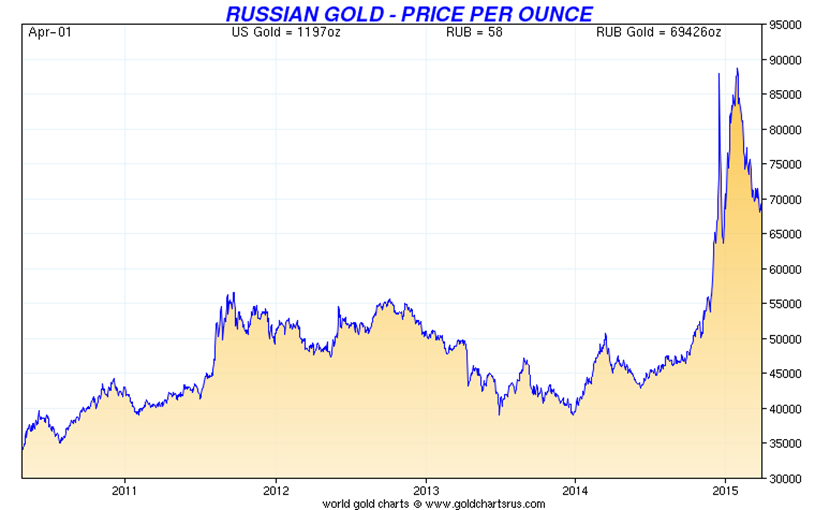
Gold in Russian Ruble - 1 Year
Currency depreciation, inflation fears and falling wages are weighing on average Russians and leading them to buy gold and silver bullion and some are making "unusually large purchases" of gold jewellery.
A large Russian chain of jewellery stores, Adamas, with 250 outlets across the country saw "same-store sales climb 40 percent in December," according to a report from Bloomberg.
The role of gold as a store of value in times of high inflation is well known to Russians. "Many are still scarred by the memories of the ruble devaluation of 1998, which sent the annual inflation rate over 100 percent several months later" according to Bloomberg.
Inflation rose 17% in February against 6% for the same period in 2014. Since the economic crisis in Russia took root gold price in roubles has risen substantially.
GoldCore
Gold in Russian Ruble - 5 Years
Between October and early January gold surged from around 50,000 roubles an ounce to over 87,000 roubles an ounce.
However, with the price of Russia's main exports - oil and gas - stabilising at lower levels, the rouble has also stabilised following a collapse of 46% last year. Gold has since retraced some of its gains and now trades at 70,000 roubles - up from below 45,000 in June 2014.
However, the crisis does not look like ending any time soon. People in Russia continue to struggle. Real wages have declined 9.9% in February when compared to the same time last year. The Russian government is projecting a 3% contraction in the economy this year.
Bloomberg report on how for Avito - Russia's largest classified ad website - business is booming as Russians buy and sell used goods to raise cash and make ends meet. It has seen a 43% increase in goods for sale since the crisis began.
GoldCore
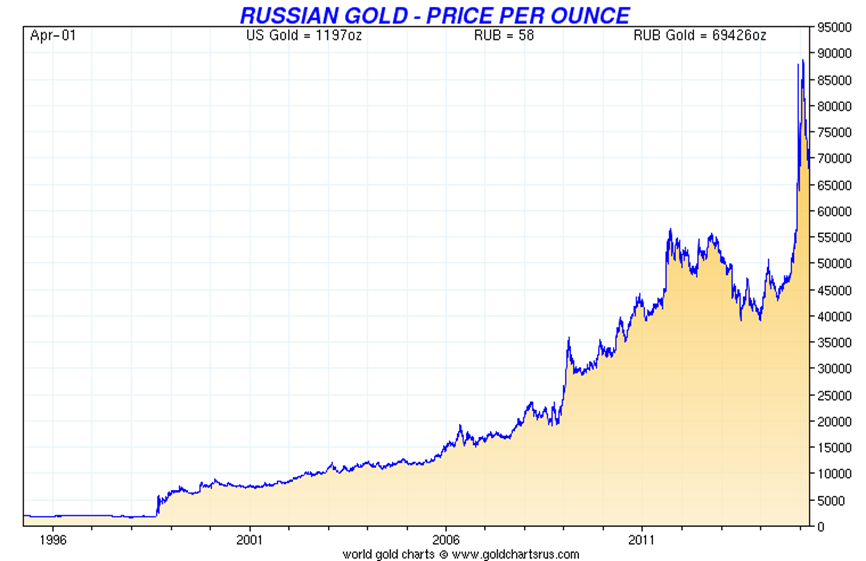
Gold in Russian Ruble - 20 Year
Canned food businesses are also thriving - sales are up 10% - suggesting that Russians fear sustained crisis and potential supply chain disruptions. War frequently leases to supply chain disruptions and shortages of food, energy and staples.
Russian people suffered many economic crises over the course of the past century and the protective function that gold can play is understood by many.
“The faith many people have in gold is rising as instability increases,” Adamas executive director Maksim Vainberg said in an e-mail. “Unlike home electronics, gold jewelry can be always resold.”
The depreciation seen in the ruble is likely to be seen by other fiat currencies in the coming months and years as competitive currency devaluations and currency wars intensify.
Click here in order to read GoldCore Insight – 
Currency Wars: Bye Bye Petrodollar – Buy, Buy Gold

MARKET UPDATE
Today’s AM LBMA Gold Price was USD 1,201.50, EUR 1,110.91 and GBP 811.11 per ounce.
Yesterday’s AM LBMA Gold Price was USD 1,181.25, EUR 1,099.50 and GBP 800.36 per ounce.
GoldCore
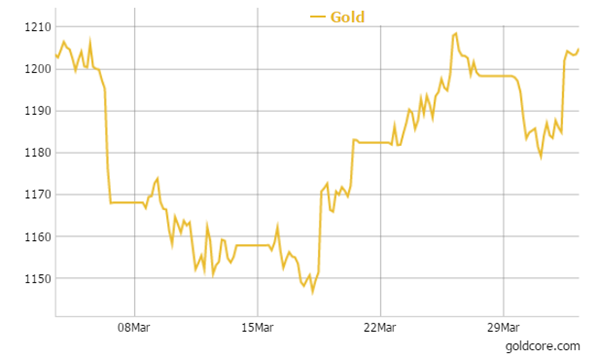
Gold in USD - 1 Month
Gold rose 1.69 percent or $20 and closed at $1,204.20 an ounce yesterday, while silver gained 1.86 percent or $0.31, closing at $16.96 an ounce. Overnight in Singapore, gold prices went sideways prior to very slight gains in London this morning.
Gold is hovering above $1,200 an ounce after the nearly 2 per cent gain yesterday, its biggest single-day rally since January 30.
GoldCore
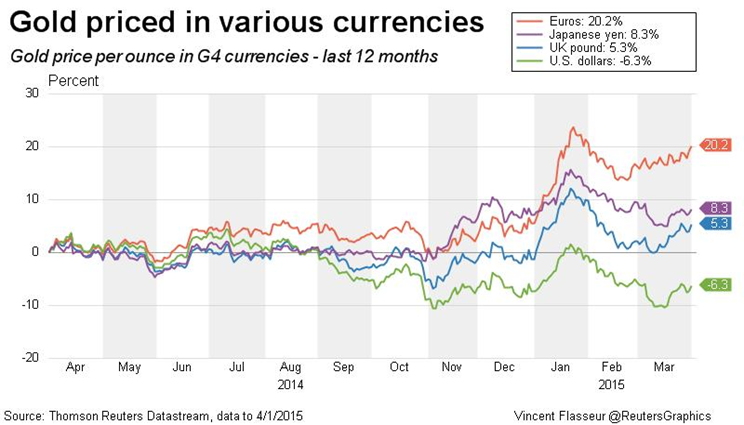
Gold priced in euros is down 0.4% this morning, underperforming spot after posting it biggest quarterly rise since Q3 2011 in the first quarter, rising 12.7%. This was largely due to a particularly strong performance in January, when it rose 16.2% prior to weakness in February in particular.
Gold ETFs posted their first net inflows in Q1 since Q4 2012 due to heavy inflows in January. Although March saw net outflows of 55.7 tons on dollar price weakness.

Wednesday, April 1, 2015

Greek FinMin: "Greece Will Adopt the Bitcoin If Eurogroup Doesn't Give Us A Deal"


While Greece’s lenders are pushing the Greek government to accept their terms in order to allocate funds so the country will not go bankrupt, Greek Finance Minister Yanis Varoufakis seems to have another ace up his sleeve. The second top thinker in the world according to prospect magazine surprised even his closest aids at a secret meeting when he said “We ‘ve had enough, we ‘ll run on Bitcoin.”
Sources very closed to Greece’s minister of finance told Greek Reporter that today Yanis Varoufakis held a top secret meeting with high-ranking finance ministry officials to prepare them in case negotiations at the upcoming Eurogroup fail. The anonymous source noted that everybody in the room was staring at each other when Varoufakis – also a prominent blogger – said “We ‘ll go to Bitcoin, we will be ahead of all the world economies and although it may be painful in the beginning, Greece’s economy will thrive in the long term.”
The Greek Finance Minister went on to explain what is the cryptocurrency and how it will be implemented into Greeks’ day to day life by using a special mini computerized card with a chip. All citizens will carry the card as an electronic wallet. The card will be distributed for free to all Greek citizens via the local tax offices but it will also be available for purchase at the country’s entry points for 45 euros, or 0,20 Bitcoin each. The sale of the card to tourists is expected to be another form of revenue for cash-strapped Greece.
“This is the smartest move to beat corruption and tax evasion, all transactions will be recorded to the Greek Ministry of Finance new secure and dedicated Bitcoin servers and we ‘ll be able to track transanctions at any given moment,” said Varoufakis defending his decision.
Many officials objected saying that Greece doesn’t have the knowhow to start such a global movement but the Greek Finance Minister said that he does what the Ancient Greeks would do in his position – and that is: be the future!
“As Greeks we are innovators, look at our history,” exclaimed Varoufakis who added “The first computer was used in Greece, the mechanism of Antikythira, nobody knew what we were starting then.”
“The future starts in Greece and we will be the first country to use the currency of the future, a currency that doesn’t allow third parties to tell us what to do or how to live, this is the Greek thing to do,” said the Greek minister.
Bitcoin uses peer-to-peer technology to operate with no central authority or banks; managing transactions and the issuing of bitcoins is carried out collectively by the network. Bitcoin is open-source; its design is public, nobody owns or controls Bitcoin and everyone can take part while it can be used for transactions worldwide.
Earlier in the day German Finance Minister Wolfgang Schaeuble had made statements putting down once again Greece’s negotiation efforts and this might have been the reason his Greek counterpart held this important meeting today.
“This is the way to be ahead, they want us to back up and they say we don’t have a clue on what we do, but this is the solution for Greece’s future,” said Varoufakis according to the same high-ranking finance ministry official who was present at the meeting.
Alexis Tsipras, the country’s prime minister who is younger but not as digitally advanced as Varoufakis, was reluctant in the beginning. Tsipras realized the advantages of such a move during a special session the Greek Finance minister held for the Greek Prime Minister at Maximos Mansion during the weekend. The session was also attended by other leftist government members who needed to be prepared and lead the way in using the Bitcoin when and if Greece switches.
According to a source close to the Greek Prime Minster the Finance Ministry is planning to hold free special seminars for all Greek citizens on how to use the Bitcoin. As of today a forum on the Bitcoin and its use has been set up in Greek here.  It is expected that the Greek Economy will be running on Euro and Bitcoin simultaneously at least for one year until all citizens get familiar with the use of the digital currency.
The next crucial Eurogroup for Greece’s future should be held in the next two weeks.

Yemen On Verge Of "Total Collapse" As Civilian Casualties, Ground Invasion Calls Mount

On Tuesday, we suggested that the entry of Houthi rebels into a military base overlooking the Bab el-Mandeb strait may have made a Saudi ground incursion in Yemen virtually inevitable. The 18-mile wide waterway is a critical oil chokepoint and given the potential for the conflict in Yemen to devolve into an all out proxy war between Iran and Saudi Arabia, the possibility that the strait will fall under Iranian influence via the Houthis is seen as untenable. Meanwhile, the Saudi-led coalition continued bombing raids for a sixth consecutive day and predictably, each side is now blaming the other for civilian casualties. Here’s more via Al Arabiya:
The coalition targeted two Houthi military installations in the city of al-Dhale southwest of Yemen. 

Fighter jets have targeted Houthi militia leaders, surface-to-air missile installations, ammunition storage warehouses belonging to the Houthis as well as to forces allied with former president Ali Abdullah Saleh.

In Aden, the strikes were focused on the rebel-held provincial administration complex in Dar Saad in the north of the city,reported AFP citing a military official.

He said there were "many dead and wounded" among the Houthi Shiite rebels but was unable to give a precise toll.

The headquarters of a renegade army brigade loyal to Saleh was targeted overnight in the north of Aden, as well as the city’s international airport, the military official said.

Militia fighters loyal to President Abdrabbu Mansour Hadi have captured 26 Houthis during the fighting in Aden, one of their leaders said.

In the western port city of Hodeida, four civilians were killed and 10 injured when a dairy was hit in the night, said medical sources.

The circumstances of the bombing were unclear, with some witnesses saying the dairy was hit by a coalition air strike and others blaming pro-Saleh forces.
The mounting civilian death toll has prompted the UN to warn that the country is on the verge of “total collapse,” as the nation which President Obama just months ago cited as a success story in the war on terror rapidly devolves into sectarian violence on the way to “failed state” satus. 
Via Al Jazeera:
UN rights chief has said that Yemen is "on the verge of total collapse" as Saudi-led coalition continues to bomb Houthi positions.

"The situation in Yemen is extremely alarming, with dozens of civilians killed over the past four days," UN High Commissioner for Human Rights Zeid Ra'ad Al Hussein said on Tuesday.

"The country seems to be on the verge of total collapse".

Aid groups have warned of a humanitarian crisis unfolding with air and sea blockades making it impossible to send desperately needed assistance as casualties mount.

The UN children's fund said that at least 62 children had been killed and 30 injured during the fighting over the past week…

But the spokesman for the Saudi-led coalition said it does not intend to kill civilians even though the Houthis had moved fighters into villages.

"Collateral damage can happen... but I confirm to you that the coalition takes all care," said Brigadier General Ahmed Assiri.

On Tuesday, air strikes targeted two Houthi-held camps and Guard soldiers in the southern town of Daleh, a Guard airbase in the southwestern city of Taez and the Houthi stronghold of Dhammar, south of Sanaa.

On the ground, deadly clashes have broken out between the rebels and tribes, militiamen and residents who oppose their power grab, the AFP news agency reported.

Yemeni military officials said Houthi rebels have taken up positions overlooking the strategic Gulf of Aden, raising the risk they could threaten the global shipping route with heavy weapons, the AP news agency reported.
And even as the Saudis claim their is no immediate need to put boots on the ground, rebel and Saudi forces are now exchanging rocket and artillery fire across the border in what Reuters calls “heavy clashes.” We’ll leave you with the following from the Yemeni foreign minister: 
  • YEMEN FM CALLS FOR COALITION TO SEND GROUND TROOPS: AFP

Greece Hints At Default, Russian Pivot:"Will Not Respect IMF Deadline" - What Happens Next

Update: GREECE GOVT DENIES PLAN TO DELAY APRIL 9 IMF PAYMENT: REUTERS
For now the algos can't decide if Greece is joking about making the payment or joking about not making the payment.
* * *
The hints are growing louder that the Troika-Greece standoff will not end well for either side. Spiegel is reporting that Greek Interior Minister Nikos Voutzis has stated:
"If no money is flowing to 9 April, we will first determine the salaries, pensions pay here in Greece and then ask our partners abroad to achieve consensus and understanding that we will pay 450 million euros to the IMF not on time,"
In other words...
  • *GREECE DOESN'T WANT TO RESPECT IMF APRIL 9 DEADLINE: SPIEGEL
And adds:
As of June or July, Russia and China are "complementary to an agreement with the European partners" fixed part of a new Greek "Plan A are" as Voutzis calls him.

This plan close "with a debt reduction, the end of the austerity measures and a new agreement with a growth clause".

"We want Russia is helping us rebuild the Greek economy. Both trade agreements as well as through the purchase of government bonds in the primary bond market. "

The fact that Russia buys government bonds directly from the Greek State to the country's creditworthiness rise, credit spreads and spreads will automatically fall. Specifically, it should also go state-wide Russian investment projects, especially in the field of energy and transport.
It seems likely that Greece can make payments covering pensions and wages for public sector workers in March, but beyond today the picture is far less certain. Even if Greece manages the 9 April payment, it has to roll over €1.4bn of short-term debt (T-bills) on 14 April and a further €1bn on 17 April – a much tougher proposition given the recent ECB decision to legally limit the amount of T-bills that Greek banks can hold. This means they won’t be able to increase their share of the debt to cover for foreign owners who are unlikely to roll it over. 

150401_Open_Europe_graph_Greek_Debt_Repayments itemprop=

So what happens if Greece does not pay the IMF? How serious would this be? 

Are countries often late in paying the IMF?

While it is well known that no country has defaulted on the IMF in its 70-year history, it is less well known that there have been a number of late payments. Furthermore, as the chart below shows, there continue to be a sizeable amount of arrears with the IMF outstanding (the chart is in Special Drawing Rights, 1 SDR = $1.38 currently). 

150401_Open_Europe_graph_Money_owed_to_IMF itemprop=
That said, the large majority of these arrears are made up of countries such as Sudan, Zimbabwe and Somalia – not Greece. Furthermore, the total amounts are far below what would amass if Greece stopped making regular payments to the IMF – its total payments this year to the IMF are €9.7bn. 

IMF internal reaction

The first step would be the IMF reaction. As detailed in the IMF’s ‘Strategy on Overdue Financial Obligations’, there would actually be little action until 1 month has passed. Before then, the Fund would continue to push the state for prompt payment. After a month, the IMF’s Managing Director Christine Lagarde notifies the IMF Board that an obligation is overdue.  This is the point where the country is officially considered to be overdue on the payment, in the sense that this is where the knock-on effects would kick in. 

Potential knock-on effects

The real problem may not actually be the IMF reaction – given its presence as senior creditor it is confident of getting paid back in full at some point – but the knock on effects of not making good on payments to the IMF. 
IMF stops cooperating with Greece – One of the biggest problems for Greece is that it is still working with the Fund and relies on its sign off (as part of the ‘institutions’) to get its current review completed and therefore funding released. The response of the fund on the ground will therefore be important. Of course, the fund finds itself in a bit of a circular position. It is unlikely to get paid if it does not approve Greece’s review, but how can it approve the review if it is not getting paid? 
Gap with creditors grows, reputation harmed – Linked to the above, given that not paying the IMF is usually a course of action reserved only for war torn countries or those on the fringes of the international system, not to mention severly underdeveloped economies, Greece could see its reputation severely dented. Furthermore, it is possible that Greece’s creditors will see that Greece has decided to pay wages and pensions first rather than meet its commitments to them. Whether or not this is a fair assessment, this could drive further animosity between the two sides. 
Market funding becomes even harder - At this point in time this might be largely irrelevant given that Greece is locked out of the markets for the foreseeable future in any case, but not paying the IMF would likely be the final nail in the coffin, ending hopes of returning to the markets soon even if some agreement is found with Eurozone partners. Usually, the move would also be expected to raise the cost of short term debt, but given that these go almost entirely to Greek banks who have little choice but to buy them the impact could be limited. 
Possible default on Eurozone loans – Greece’s Master Financial Assistance Facility Agreement with the European Financial Stability Facility (EFSF) notes that it could be considered to be in default on the loans from the Eurozone if it 
has overdue charges on outstanding purchases and the Managing Director of the IMF has notified the Executive Board of IMF that such repurchases or such payment of charges have become overdue.
Essentially, after one month, when Lagarde notifies the IMF Board about the overdue payments Greece can be considered in default on its EFSF loans as well. However, this is all carefully worded and qualified – it explicitly says the EFSF is “not obliged to” take such action. In the end, it seems to ultimately depend on the decision of the EFSF. It seems unlikely that it would declare the full loan to be in default. That said, pressure would rise within certain member states and national parliaments for some decisive action. Eurozone partners could also use this to further extract concessions from the Greek government. (The original bilateral Eurozone loans also include similar clauses). 
Potential cross default on private sector bonds – Under the 2012 debt restructuring, the new Greek bonds which investors were given were issued under English law and included both ‘cross default clauses’ (meaning if they are considered to have defaulted on other obligations they also default on these bonds) and ‘co-financing clauses’ (money for repayments is to an extent pooled between the bonds and the EFSF). However, these look to only apply to the EFSF loans rather than the IMF loans. As such, default would have to be triggered on the EFSF as well for these to be activated. It is worth noting that the rating agency Fitch said in a recent statement that arrears to the IMF alone “would not in and of themselves constitute a rating default” but would be “credit negative” and lead to a further downgrade. 
Potential cross default on ECB – The exact terms of the bonds held by the ECB (purchased under its Securities Markets Programme) is less clear since the swap was done in a much more secretive way to ensure the bonds were not captured by the 2012 restructuring. The ECB was issued new bonds under exactly the same terms and maturities. Reports suggest that the bonds remained issued under Greek law. It’s not clear if they include cross default clauses at all and, if they do, whether they would be applicable to bonds issued under English law and/or the loans. 
ECB limits or cuts off ELA – It is uncertain then whether default clauses on any loans or bonds would be triggered. Even if they are not, the ECB may reconsider its provision of Emergency Liquidity Assistance (ELA) to Greek banks and would likely refuse to raise the limit further. As noted before, this is likely because of the huge reliance of Greek banks on the state – which would clearly be struggling for cash. Given that the very public act of not paying the IMF may further increase uncertainty and deposit outflows, the impact of limiting ELA could be exacerbated and cause a serious funding crunch for Greek banks and indirectly the economy and the state. 
Overall, the short term impact of not paying the IMF may not immediately be dire in economic and financial terms, though of course it would involve serious reputational damage and further widen the already mammoth gap between Greece and its creditors. It may take a month before cross default clauses could be triggered and even then it rests with decisions of highly political institutions such as the EFSF. Such decisions would likely be managed to achieve the least controversial ends, but equally could quickly spiral out of control. Less certain is the response of the ECB, which would once again be the key player. 
In the end, it would still not be advisable for the Greek government to test this course of action. We still expect a deal to be found, and largely on Eurozone terms.
*  *  *
The market appears less sure...

Greek Fears, Weak Data Send Gold Surging Over $1200

A combination of Greek default fears rising (safety reach) and considerably weaker than expected data (moar easing) has sparked a $20 surge in gold prices this morning, back above $1200...