Tuesday, March 3, 2015

Why Gold Manipulation is a Global Effort

The Daily Reckoning Presents... Jim Rickards explains why the U.S. helps manipulate the price of gold for China’s benefit..

A lot of people think about gold as a percentage of a country’s total reserves. They are surprised to learn that the United States has 70 percent of its reserves in gold. Meanwhile, China only has about 1 percent of its reserves in gold. People look at that and think that’s an imbalance. But those are not very meaningful figures in my view.

The reason is that a country’s reserves are a mixture of gold and hard currencies, and the currencies can be in bonds or other assets. The United States doesn’t need other currencies. We print dollars, so why would we hold euros and yen?

The U.S. doesn’t need them, so it makes sense that the country would have a very large percentage of its reserves in gold. China, on the other hand, has greater need for other currencies.

A better metric, in my opinion, is to look at a country’s gold holdings as a percentage of GDP. GDP is a representation of how big a country’s economy is. It’s the gross value of all the goods and services.

There are different measures of money supply -- M3, M2, M1, and M0. In a money economy, however, you can say that the country’s gold holdings are the real money. I call a country’s gold reserves gold “M-subzero”.

The IMF officially demonetized gold in 1975. The U.S. ended the convertibility of gold in 1971. Gold disappeared “officially” in stages in the mid-1970s. But the physical gold never went away.
The scene: the Platts oil conference. The location: London. The time: May 2014.
Today, the US has about 8,000 tons. We haven’t sold a significant amount of gold since 1980. We dumped a lot of gold in the late 1970s to suppress the price, but none after that. So one of my questions for central bankers is, if gold is such a ridiculous thing to have, why are we hanging onto it? But that’s a separate question.

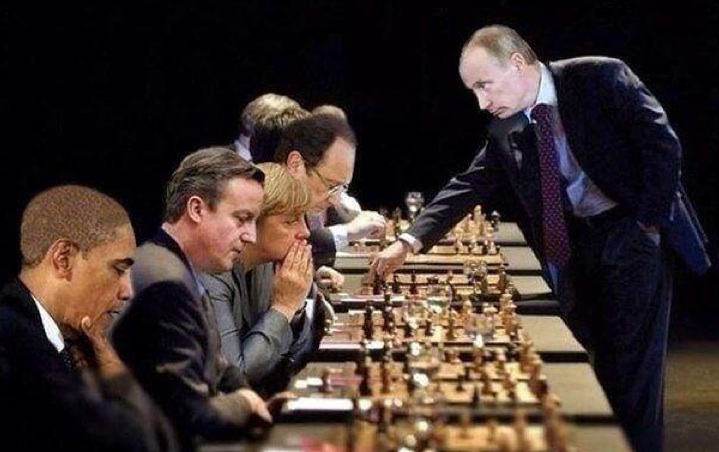
Right now, China officially does not have enough gold to have a “seat at the table” with other world leaders. Think of global politics as a game of Texas Hold’em.

What do want in a poker game? You want a big pile of chips.

Gold serves as political chips on the world’s financial stage. It doesn’t mean that you automatically have a gold standard, but that the gold you have will give you a voice among major national players sitting at the table.

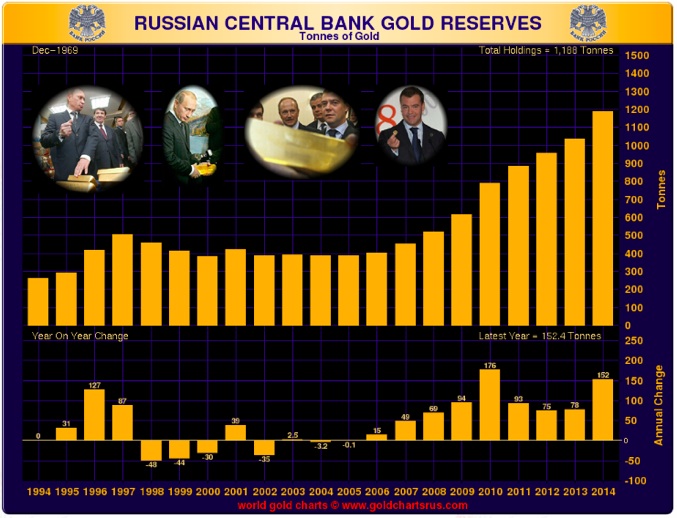
For example, Russia has one-eighth the gold of the United States. It sounds like they’re a small gold power -- but their economy’s only one-eighth as big. So, they have about the right amount of gold for the size of their economy.

The U.S. gold reserve at the market rate is about 2.7 percent of GDP. That number varies because the price of gold varies -- but it’s around 2.7 percent. For Russia, it’s about 2.7 percent. For Europe, it’s even higher -- over 4 percent.

In China, that number is 0.7 percent officially. Unofficially, if you give them credit for having, let’s say, 4,000 tons, it raises them up to the US and Russian level, but they want to actually get higher than that because their economy is growing.


Here’s the problem: If you took the lid off of gold, ended the price manipulation and let gold find its level, China would be left in the dust. It wouldn’t have enough gold relative to the other countries, and because their economy’s growing faster and because the price of gold would be skyrocketing, they could never acquire it fast enough. They could never catch up. All the other countries would be on the bus while the Chinese would be off.

When you have this reset, and when everyone sits down around the table, China’s the second largest economy in the world. They have to be on the bus. That’s why the global effort has been to keep the lid on the price of gold through manipulation. I tell people, if I were running the manipulation, I’d be embarrassed because it’s so obvious at this point.

The price is being suppressed until China gets the gold that they need. Once China gets the right amount of gold, then the cap on gold’s price can come off. At that point, it doesn’t matter where gold goes because all the major countries will be in the same boat. As of right now, however, they’re not, so China has though to catch-up.
Once China gets the right amount of gold, then the cap on gold’s price can come off.
There is statistical, anecdotal and forensic evidence piling up for this. All of it is very clear. I’ve also spoken to members of Congress, the intelligence community, the defense community and very senior people at the IMF about it.

China is our largest trading partner. It's the second largest economy in the world. The US would like to maintain the dollar standard.

I've described some catastrophic scenarios where the world switches to SDRs or goes to a gold scenario, but at least for the time being, the US would like to maintain a dollar standard. Meanwhile, China feels extremely vulnerable to the dollar. If we devalue the dollar, that's an enormous loss to them.

That’s why, behind the scenes, the U.S. needs to keep China happy. One way to do that is to let China get the gold. That way, China feels comfortable.

If China has all paper and no gold, and we inflate the paper, they lose. But if they have a mix of paper and gold, and we inflate the paper, they'll make it up on the gold. So they have to get to that hedged position.

Gold is liquid, but it's a fairly thin market. If I call JP Morgan and say, "Hey, I want to buy 500 tons of gold," I can't do it. That would be a huge order. An order like that has to be worked between countries and central banks behind the scenes.
If I call JP Morgan and say, “Hey, I want to buy 500 tons of gold,” I can’t do it.
It's done at the BIS, the Bank for International Settlements, in Basel, Switzerland. They're the acknowledged intermediary for gold transactions among major central banks and private commercial banks.

That's not speculation. It's in the footnotes of the annual BIS report. I understand it's geeky, but it's there. They have to acknowledge that because they actually get audited. Unlike the Fed and unlike Fort Knox, the BIS gets audited, and they have to disclose those kinds of things.

The evidence is there. China is saying, in effect, "We're not comfortable holding all these dollars unless we can have gold. But if we are transparent about the gold acquisition, the price will go up too quickly. So we need the western powers to keep the lid on the price and help us get the gold, until we reach a hedged position. At that point, maybe we'll still have a stable dollar.”

The point is that is that there is so much instability in the system with derivatives and leverage that we're not going to get from here to there. We're not going to have a happy ending. The system's going to collapse before we get from here to there. At that point, it's going to be a mad scramble to get gold.

Regards,

James Rickards
for The Daily Reckoning

P.S. Almost a third of the official gold in the world is stored for safekeeping in only two places -- the Federal Reserve Bank of New York and the Bank of England. That gold does not belong to the U.S. and the U.K.; it belongs to nations around the world.

Recently, those customers have started to worry that the U.S. and U.K. might confiscate their gold in a financial panic. This has led to a repatriation movement to return the gold to the rightful owners. Austria is the latest to sound an alarm. When the next crisis hits -- perhaps within the next six months to a year -- there will be a run on physical gold. You won’t be able to get it at any price.

Peter Schiff Warns "Don't Be Fooled By The Madness Of Crowds"

Going into 2015 the economic outlook held by the U.S. investment establishment could not have been much more positive, and more unified. Pundits saw all the variables aligning to create the best of all investment worlds, a virtual "no-brainer" of optimism. Many believed that the 5.0% annualized growth in 3rd quarter would stay strong in the 4th Quarter and then usher in a strong 2015, which many believed would be the best economic year since the crash of 2008. The only question that divided most forecasters was how good the year would be.
 
High degrees of certainty can be dangerous. Herd mentality can cause investors to chase returns en masse and pile into positions that may already be overvalued. But herds can be spooked, most often by unexpected developments which can catch the herd wrong-footed and spark major movements when the masses scatter at the same time. When that occurs, those who resisted the herd may find themselves rewarded. We believe that we are approaching such a point.
 
Although the employment reports continue to bathe the economy in the diffuse light of recovery, many of the less followed economic indicators have further diverged from expectations in the opening months of 2015. Many economists initially believed that GDP in the 4th quarter 2014 would come in at an annualized pace north of 3.0%. But, in January the actual number came in at 2.6% (which was revised down to 2.2%). Recent data in such categories as consumer spending (which after falling in December, declined again in January  - the first consecutive monthly declines since 2009), factory orders, trade, manufacturing, and business investment have missed on the downside. But these lesser reports are often explained away and have not made much of a dent on overall optimism.
 
In the six years since the Great Recession began in 2008, the economy has been boosted by both monetary and fiscal stimuli. The Federal Reserve has held its overnight rate at 0% while expanding its balance sheet by almost $4 trillion, and the Federal government had run four consecutive $1 trillion plus budget deficits (before pulling back to less than half a trillion annually more recently). But despite these unprecedented levels of stimulus, real GDP growth in the U.S. averaged just 2.2% from 2010 through 2014, which compares with an average of almost 3.5% in the post-WWII period. If this substandard growth is all we could achieve with the floodgates wide open, why should we expect that the economy will improve in 2015 if the stimulus doesn't return, as few expect it will?
 
Despite the records being set almost daily on Wall Street, (today the NASDAQ eclipsed 5,000 for the first time in almost 15 years), optimists claim that the market is not overvalued because the current S&P 500 price-to-earnings ratio, of about 19 times trailing 12 months earnings, is not too far above the historical norm of about 14. But most investors have not considered the extraordinary factors that helped push up earnings, artificially we believe, in 2014.  
 
According to Bloomberg, in 2014 S&P 500 companies spent an estimated $565 billion (or 58% of corporate earnings) on share buybacks, a figure that is extremely high by historical standards. Money spent on buybacks is not available to purchase new plant and equipment, to fund research and development, or to spend on marketing and logistics. In that sense, buyback spending generates current earnings at the expense of future earnings. Corporate results have also been boosted by zero percent interest rates, which have allowed businesses to borrow cheaply.
 
To factor out these short-term earnings distortions, we suggest that investors should look past current P/E ratios and instead look at Cyclically-Adjusted-Price-to-Earnings (CAPE), which is also known as the Shiller Ratio, a metric that looks at earnings over a 10-year period thereby smoothing out cyclical and economic anomalies. Looked through a lens of CAPE ratios, the U.S. markets begin to look very expensive in comparison to other global markets. The graph below tells the tale:
 
In addition, U.S. stocks currently offer some of the lowest dividend yields to compensate investors for the higher valuations (see chart above). The current estimated 1.87% annual dividend yield for the S&P 500 puts it far below the annual dividend yields of Australia, New Zealand, Finland and Norway.
 
In 2014 the S&P 500 outperformed stocks in the rest of the world (as represented by the MSCI Index of non-U.S. global markets) by an astounding 20%. This was by far the largest gap in the past 13 years.  But on Wall Street, investors generally chase returns. After six consecutive years of positive gains in the S&P 500 (and more than 200% return since March of 2009), few forecasters see any reason to suspect that the upward run of U.S. stocks will end anytime soon.
 
But should we really expect another year of such results? Would it not be more logical to suggest that the slowing economy will crimp potential over-performance of U.S. markets in 2014? Given that the S&P 500 has not been among the top performers over a 10-year timeframe [see 2015 Global Investor Newsletter] news, would we not at least expect the index to begin moving back to trend, and perhaps underperform world markets in coming years?
 
Don't be fooled by the madness of the crowd. The U.S. is not the sole remaining engine of world growth as the talking heads would seem to have you believe.

Richard Russell – The Shocking Secret Central Planners Are Hiding From The World

As people continue to digest breaking news out of Greece and Ukraine, today the Godfather of newsletter writers, 90-year-old Richard Russell, discussed the shocking secret central planners are hiding from the world.  Russell also spoke about how this will impact people across the globe.
King World News - Just Buy The Fucking Dip Setting Up The Mother Of All Stock Market Crashes
New Record Highs
Richard Russell: "I scour the newspapers for hints of coming turning points. By my calculations, the markets remain bullish. Massive amounts of money have gone into the US dollar and US Treasury Bonds. New record highs in the Dow attract the retail public.
My Largest Investment
I follow numerous gold items daily. Something is going on with gold. There’s a secret that’s causing every central bank plus Russia and China to be buying gold. Personally my biggest investment position is in physical silver and gold, plus a large position (for me) in TriContinental Preferred (TY.P), an excellent preferred stock with a fixed dividend of $2.50 per share.
KWN - BREATHE Away Excess Pounds?
It's All About Peace Of Mind
I’m not looking for appreciation or profits at this time. What I want more than anything else is peace of mind. From an investment standpoint, physical silver and gold give me peace of mind. In my prayers, I ask God to give me peace of mind.
KWN Fleckenstein II 2:8:2015
Fully Invested Bears
On another subject, the best description of large investors today is that they are fully invested bears. Everybody is hoping to identify the top of this bull market. In their efforts to identify the top they’re using strategies that identified previous bull market tops. I don’t think it will work. This bull market has surpassed previous upside limits, and I believe this will continue — we will see price earnings ratios that have never been seen before. We are already seeing minuscule dividend yields never seen before. 
As I write an hour before the close, the Dow is at another record high. The Dow has been climbing in a sawtoothed pattern with a new record high approximately every other day. If the Dow has predictive abilities, which I think it does, we’re looking at a glorious time for the US over the next 4-6 months. At the same time, spot gold is selling at 1205.20, still bullishly above its support at 1200.
King World News --- Richard Russell - What To Do When The Financial Hurricane Strikes copy
What To Do? 
Subscribers who have already bought into this market might add another 50% to their total package. If the market continues on its bullish path, we’ll add another 25% to our total position. If the market continues to rise, we’ll add progressively smaller portions to our total package. 
In order to make large profits, one must take a large position in the market. But with the Dow at a record high, it would be foolhardy to take a large position in the market. No tree grows to the sky, but this stock market appears to make a mockery of that old rule.
King World News - The Death Of Free Markets As Deflation Engulfs The World
Watch Out For Greed
The retail public can resist anything but temptation. A series of new highs in the Dow is the stock market’s equivalent to temptation. This is not the time to be greedy. 
………………………………..
Surprise, negative news is creeping out about the US economy and if this continues, which I think it will, any boost in interest rates will be out as far as possible.
If it turns out that we’re back in a recession, I would not discount the return of quantitative easing. The world is caught in a cycle of deflation and deleveraging and every central bank is fighting the deflationary trend. I continue to think that the best defense against deflation is a sudden overnight boost in the price of gold. Gold sits at the bottom of an inverted pyramid. A huge increase in the price of gold would help minimize the effect of debt and deflation.
King World News - Richard Russell - Richard Russell - The Shocking Secret Central Planners Are Hiding From The World
Shocking Secret Central Planners Are Hiding From The World
Why is nobody talking about a potential boost in the price of gold yet? Has the Fed put a sheet of censorship over a potential increase?
KWN Russell I 3:3:2015
What Do Central Banks Know?
Almost every central bank is now buying gold along with China and Russia. What do they all know that we don’t? A major change in the monetary system lies ahead. Advice: Buy physical silver and gold while they are cheap and readily available."

50-Year Veteran Warns There Is No Way Out Of This As World Heads For Next Crisis

50-Year Veteran Warns There Is No Way Out Of This As World Heads For Next Crisis

With the eyes of the world focused on soaring stock markets, today a 50-year market veteran warned King World News that thre is no way out of this as the world heads for the next crisis.  He also discussed the truth about what is really happening around the world.

John Embry:  I was struck in the last 24 hours by the news of the Austrian bad bank halting payments on $11 billion in debts and referring to a hole in their balance sheet of over $8 billion.  At the same time I noticed that in this new Greek bailout that is being proposed, Spain is going to be contributing 14 percent of the money….

So we have the bankrupt financing the bankrupt.  This is turning into the theater of the absurd.  It’s symptomatic of the fact that the debt crisis, which started the 2008 global financial crisis, has not gone away at all.
World Debt Over $200 Trillion
It was recently estimated that global debt has grown by $60 trillion since 2008.  The total debt now comfortably exceeds $200 trillion.  So I think this development with the Austrian bad bank should make debt holders everywhere very uncomfortable because I think it’s symptomatic of how much bad paper is out there.
Meanwhile In The U.S.
Turning to the United States, the two fastest-growing private-sector areas of debt in the U.S. since the global financial crisis enveloped the world some 7 years ago are student loans and subprime auto loans.  This isn’t really productive debt in the first place, but an even more disturbing aspect of the situation is that significant quantities of this debt will never be paid back.
KWN Embry I 3:2:2015
As you are aware, Eric, a lot of these kids are running up enormous debts getting their university degrees, and the kind of jobs they are getting post-graduation barely let them survive, let alone pay back any debt.
KWN Pento V 3:1:2015
But the student debt is secondary to the subprime auto loan junk.  This is the same thing that was going on before the last crisis, except it was in housing.  Well, at least a house is better collateral than a car, which is going to become worthless over time.
KWN Embry II 3:2:2015
Cracks In U.S. Economy Starting To Show
So this is not a good development but it’s all part and parcel of the U.S. economy and its financial structure.  But even with all the phony statistics trumpeting economic strength that the U.S. government issues, I think the cracks are starting to show everywhere — housing, retail sales, manufacturing, etc.  We are heading toward a major crisis and what we are debating is just how long it’s going to take to get there.
So when I watch the gold and silver markets I just roll my eyes.  Anybody who denies that gold and silver are being aggressively manipulated on the Comex and the LBMA is simply lying.  Today gold and silver were trading strong in the East and as soon as trading shifted to the West, gold came under severe pressure and it’s now trading lower than it was the day before.
This is not normal action given the backdrop of the economy.  My message is that the opportunity to buy gold and silver will not be there forever and you best use this unwarranted weakness to get your positions right now.
Greyerz, Pento And Celente Spot-On
I just want to add that the information provided in the KWN interviews with Egon von Greyerz, Michael Pento and Gerald Celente is absolutely spot-on.  The problem in the world is excessive debt and it cannot be rectified unless you have either a hyperinflation or a hard debt deflation like the 1930s.  One of the two is inevitable and it’s being brilliantly pointed out by people like Greyerz, Pento and Celente.”
KWN Roberts II 2:28:2015
Embry added:  “Whether people love him or hate him, Putin is not a stupid guy.  And I don’t think it would have been in his best interest to be involved in assassinating one of his leading dissidents at this point.  So this idea that is being suggested by Gorbachev that it was a false flag or Paul Craig Roberts suggesting it was a hit by the CIA may have some merit.  I don’t know but I just don’t think we can say Putin had this guy taken out because it just doesn't make sense.”

Monday, March 2, 2015

David Stockman Warns "It's One Of The Scariest Moments In History"

"The Fed is out of control," exclaims David Stockman - perhaps best known for architecting Reagan's economic turnaround known as 'Morning in America' - adding that "people don't want to hear the reality and the truth that we're facing.The following discussion, with Harry Dent, outlines their perspectives on the looming collapse of free market prosperity and the desctruction of American wealth as policymakers "take our economy in a direction that is dangerous, that is not sustainable, and is likely to fully undermine everything that's been built up and created by the American people over decades and decades." The Fed, Stockman concludes, "is a rogue institution," and their actions have led us to "one of the scariest moments in our history... it's a festering time-bomb and we're not sure when it will explode."


Key Excerpts from the detailed interview:
David Stockman: People don't want to hear the reality and the truth that we're facing. But I think there is an enormous appetite out in the country to get a different perspective than what you have from the media day in and day out, so I say the fed is out of control. Its balance sheet is exploded. It's printing money like never before.
Zero interest rates for 70 months have basically destroyed the pricing function in the financial markets. I said that as a result of this, Wall Street has become a huge casino which basically rewards gamblers, but it is not functioning as a capital raising, capital allocating instrument, which really is what the financial markets should do in a free market system. I warned about the size of the federal debt. I'm an old budget director from the Reagan days. We had a trillion dollar national debt, a 3 trillion economy when I started. Today, it's 18 trillion. Eighteen fold gain in the last 35 years versus maybe a fourfold gain in the economy. So all of these trends are taking our economy in a direction that is dangerous, that is not sustainable, and is likely to fully undermine everything that's been built up and created by the American people over decades and decades.
So people don't want to hear the warning. They don't want to hear the truth in the establishment, in Wall Street, in Washington, but I think out in the country they must.
*  *  *
David Stockman: Well it's obvious that Wall Street is addicted to cheap money and unlimited flow of new liquidity into the markets. Traders can then borrow money on an overnight basis for five basis points, which is nothing. Buy anything with a yield like a ten-year or five-year bond or speculate in stocks that they think might be going up or even get fancier and go into derivatives or commodity futures or whatever. And then capture the profit or the spread between the cheap money that the fed is putting into the overnight market and the yield or profit they're making on the asset, and they're leveraging way up.
You know, 90 percent, 95 percent in many cases. So obviously, the whole financial market is dependent on this, but it comes at a cost. It is destroying savers in America. If you worked a lifetime and saved $100,000.00, you're making $400.00 a year in interest from a lifetime of savings. I think there will be a revolt sooner or later of the American public against this disastrous crushing of the saver in order to essentially accommodate Wall Street's appetite for liquidity.
*  *  *
David Stockman: Well you know, the problem is the fed, I've described, is a rogue institution. It's operating beyond any of the legislative intent or statutory authority that's been given to them over the years. They have essentially become a national monetary planning agency that has decided they can drive the daily, weekly, monthly movement of the economy by manipulating interest rates and the yield curve by putting a put under the stock prices by essentially trying to drive the entire 18 trillion or 17 trillion US economy from Wall Street. That is fundamentally at variance with the requisites of a healthy capitalist economy. You need an honest financial market. Not a manipulated one.
You need price discovery by people that have their money at risk, not the central bank.
Harry Dent: Actually, it's a centrally planned economy, isn't it?
David Stockman: Right, exactly.
*  *  *
So David, do you think the republican congress can save us from this economic sundown that we've been discussing today?
David Stockman: Well I would like to think so, and they talk a good game, but unfortunately when push comes to shove, they're in the consensus with everyone else in the beltway in Washington and are unwilling to take on the hard issues. We are borrowing still $600 billion in the last year, six years after allegedly the great recession ended, and we are setting ourselves up for trillion dollar deficits again, the next time the economy stumbles or we have a recession or some other dislocation. The fact is the fed is not abolished the business cycle. The fed has not made the world completely safe from these kinds of dislocations. So therefore, we need to look at what's driving this huge deficit, and the answer is big entitlements and big defense spending, and the republicans are unwilling to take on the Pentagon. They want more, and they're afraid to take on Social Security and the entitlements because they believe that is going to be problematic politically.
So therefore, nothing is being done about the structure of this deficit problem, and we're just basically stumbling our way into another huge crisis in ballooning national debt.
*  *  *
David Stockman: Well, it's one of the scariest moments I think in our history, but also we need to recognize we're in uncharted waters. No central bank has ever printed this much money this long, kept interest rates at zero, fueled so much speculation. Not just here, but worldwide. Not just in the normal stocks and bonds, but the whole shale boom, for instance, in the United States was massively funded by cheap debt based on oil prices that weren't sustainable, and now that's all coming unwound. We have never had deficits of ten percent of GDP back to back, or even still four or five percent four or five years into a recovery.
We have a runaway budget where the population is getting older and older, 10,000 people are retiring every day. Nothing is being done about Social Security. It's a festering time bomb, and we're not sure how it will explode, but we know it isn't sustainable. We have a Wall Street that is more addicted to pure overnight gambling and trading and speculation for the ultra short run that is driven by robo traders, the so-called HFT money, like never before. It's unstable. That's why we see things happen like the overnight 40 percent gain with the Swiss Franc when the Swiss National Bank pulled the pay.
Forty percent overnight – not overnight, but in a couple of minutes or seconds when there were hundreds of billions of short positions in the Swiss Franc. All of these things have never existed simultaneously, not only in the United States, but worldwide. All the central banks are doing it. We're reaching the point where it's unsustainable, things are going to give and break, but the good thing is it's going to be more a disaster in the financial markets in my view, less some kind of Great Depression impact on Main Street. It will be difficult on Main Street, but Wall Street is in the gun sites of this disaster coming.
*  *  *
David Stockman: I agree. In the long run, we have to get off this debt addiction. We need to get back to sound finance both in government and households, but beginning between here and there is going to cause enormous pain for millions of households who have been herded into risky investments, junk bond funds, stock market funds, high flying biotech stocks and on and on because they were told it's the only place to be. If you put your money in a CD, you get no return. If you put your money in a safe bond, you get almost no return. Now when the big reset, as Harry calls it, happens, and the stock market drops by large magnitudes, 50 percent, more, those people who were herded into these risky investments late in life – Because remember, we have the baby boom, you know, heading towards their retirement homes, are going to be badly hurt at a time that they can't recover, and it will be a massive injustice that is being done by Washington and the fed to this current generation of middle class Americans. That will produce, in my view, a political reaction, a political revolt that will begin to say, "What's wrong here? Who believed that printing money out of thin air can make a society wealthier? Why did we do that? Who believed that we can actually create jobs and new economic output on Main Street simply by having the fed press a button and create another billion dollars?"
*  *  *
David Stockman: Yeah, I agree with that, and the point to remember is that massive money printing by central banks on a worldwide basis is inherently deflationary for two reasons. One, it fuels massive financial speculation. When we talk about speculation, we're talking about professional gamblers who borrow 95 cents and use that borrowed money that they pay practically nothing for to buy stocks or bonds or commodities or derivatives or biotech stocks and so forth as I indicated. All of that buying power is artificial. That is not coming from production today, real effort in the economy. That's coming from newly minted credit.
So it takes asset prices to unreasonable, unsustainable levels. They crash, and that creates a negative economic cycle. Secondly, massive money printing makes capital and debt too cheap to the real sector of the economy. So therefore, massive capital investments are made on the basis of cheap cost of capital, not on the basis of the likely return or sustainable return over time.
*  *  *
David Stockman: Yeah, a famous American economist once said anything that's unsustainable tends to stop. My argument is that we're at the stop point. The fed has been printing money like there's no tomorrow really for 25 years since Greenspan took over in 1987. They are now at the point where their balance sheet has become so bloated, so enormous that even the people running the fed are confused about what to do. They've painted themselves into a corner, and they're playing it by the day, and they're going to make a huge mistake. So the money printing thing is near an end.
Secondly, our political system has become totally non-functional. We have a lame duck president who can accomplish nothing, a congress that is totally paralyzed, meaning that before 2017 at the earliest, nothing will be done about our fiscal and entitlement explosion. Finally, the American people have believed falsely that all of this is going to work out. It's not going to. When they find out that the adults so called in Washington had no clue what they were doing, there is going to be a collapse of confidence, and that will flow into the system as well.
*  *  *
So it seems like this bubble bursting is inevitable. How much time do we have? Is it years, months? How will we know? Are there some clues we can look into to make sure that we're prepared?
David Stockman: There's really no magic numbers here, but it's remarkable that these central bank driven bubbles tend to peak after about six years. The dot com bubble started really in mid-1994 with the famous Netscape IPO. It crashed in March 2000, six years. The housing bubble roughly started in 2002. It totally crashed in 2008. Six years. The meltdown on Wall Street bottomed in March 2009. Add six years. 2015. I think we're at the end of this bubble simply based on the fact that they can't expand forever. They reach an asymptotic peak, and then confidence is lost, a catalyst occurs, a black swan appears, the selling begins, and there's nothing under this market. There is no safety net under this market.
*  *  *
Is there anything that can save us?
David Stockman: Yes, there are, and in the short run, that will be painful. There will be great dislocations, both in the financial markets and the real economy. But in the long run, that's a good thing. We have become so dependent on government, we have come to believe that the Federal Reserve drives the economy hour by hour, day by day. None of that is historically true. Real wealth, real prosperity comes from the sweat and from the enterprise and from the invention of people on Main Street, not the politicians on Wall Street who are on the central bank. So I think the big inflection point that we're facing is when the big crash comes, on the other side, maybe we can get back to the private enterprise system and the kind of family self-reliance and thrift and prudence that our prosperity was built on 40 years ago.
*  *  *
David Stockman: Well in The Great Deformation, I said, "We're heading towards a day of reckoning. This isn't sustainable." It's happening in real time, and in the updates, what I try to do is focus on the catalyst events, the catalyzing forces that will warn us when we're really getting to the edge of the cliff.
That is the central banks. Japan's central bank is out of control. I watch that. It's important to know what happens there because if the great money printing debt experience in Japan finally fails, it's going to be noted in markets all around the world. I watch the ECB, European Central Bank. It is divided between Germans who want to try to maintain some semblance of some money and the rest of Europe that would like to print and drown themselves in debt as far as the eye can see. It's important to watch China, which is a giant house of cards, that's on the verge of collapse, and that will ricochet around the world in terms of the countries that supply it. Australia, Korea, the so-called emerging markets, and what it'll do to the theory, which I think is false that China is the engine of growth in the world, it is not. It is the biggest speculative disaster in human history.
*  *  *
David Stockman: Well, the crisis is unfolding by the day. It is not too late to start preparing right noW. Now is the time to begin to save if you can and minimize your outlays for unnecessary luxuries. This is going to be a devastating crisis, and people will be happy down the road if they take the steps to prepare today.

Top Trends Forecaster Gerald Celente Says Now Is The Time For Gold!

Top Trends Forecaster Gerald Celente Says Now Is The Time For Gold!

With the world at a pivotal moment in history, today the top trends forecaster in the world sent King World News  an incredibly important piece stating that now is the time for gold!  Below is Celente's fantastic piece.

By Gerald Celente, Founder & Publisher of Trends Journal
Going for gold, Not Bonds
March 2 (King World News) – History is being made. A unique phenomenon is in play that few outside the business media are reporting.
Last week, for the first time in its history, Germany sold five-year bonds that guaranteed a negative yield. And Germany is not alone. Eurozone nations, including France, Belgium, Finland, Denmark, Switzerland, Netherlands, Sweden and Austria, have issued bonds with negative yields.
This means investors, as a reward for tying up their money for several years, will get less money back than they put in when the bonds mature.   
Among the rationale for investors to accept a loss is that  government bonds provide a safe haven in an uncertain economic future. And with banks trending toward negative interest rates (charging savers to hold their money) and bail-ins that permit seizure of deposits above the insured amounts, negative bond yields, rather than bank deposits, are the price paid for security.
Moreover, there are assumptions that in the current economic climate of deflation and weakening currencies, investors may get some protection should future deflation exceed the current negative bond yield.
Gold yes, bonds no
When I had forecast the beginning of the Gold Bull run in 2001, I based it in part on the 46-year low interest rates and subsequent ultra easy-money schemes Wall Street and Washington were peddling to the public. My reasoning was that the more cheap money flooding the marketplace, the less the currency would be worth. And the more money pumped into the real estate and equity markets, the greater the bubbles would grow. In November of 2007, I secured the domain name ThePanicof08.com in anticipation of the bubbles bursting. And, our Top Trend of 2008, made eight months before the Lehman Brother bankruptcy debacle, was “The Panic of ’08.”
Today, virtually anyone with an open mind and no hidden agenda – profit motive or otherwise – knows the economic facts and what they mean. The tens of trillions of central bank dollars, yen, yuan and euros, plus the unprecedented years of record low (and now negative) interest rates, have again created massive speculative bubbles in the equity markets. Therefore, growing economic uncertainty combined with increasing geopolitical instability still makes gold the safest of safe-haven investments for me.
The longstanding argument made by anti-gold equity market players that it makes no sense to invest in the precious metal because it pays no interest is absolutely no longer valid in a negative yield and negative interest rate environment.

And, while it is guaranteed that German and other bonds with negative yields will be worth less in five years than they were last Wednesday, the upside forecast for much higher gold prices in five years is far greater than gold selling for less than it is today.

Sunday, March 1, 2015

Man Who Predicted Collapse Of Euro Against Swiss Franc Warns Of Next Shock To The World

Today the man who 90 days ago remarkably predicted the collapse of the euro against the Swiss franc warned King World News about the next shock that will bring the world to its knees.

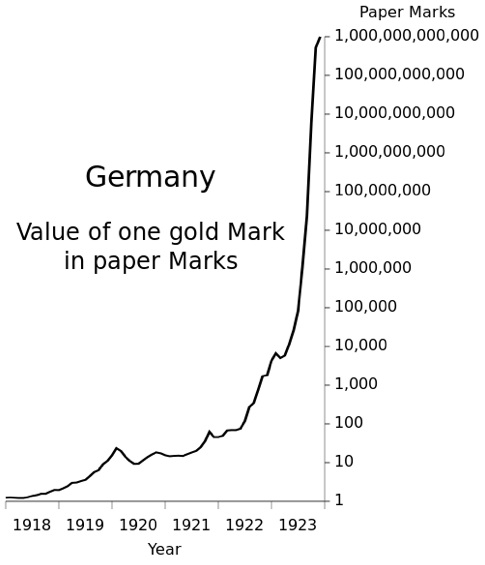
Egon von Greyerz:  Eric, it's now totally clear to me that the hyperinflation I've been expecting is becoming more persistent and is now engulfing country after country.  We are already seeing it in the periphery but it's on its way to engulfing the developed countries of the world….

Hyperinflation Is A Currency Event
Hyperinflation is a currency event.  It arises as a result of countries living above their means for a protracted period of time.  This causes massive debts and eventual money printing.
The Antidote
The asset that best defines hyperinflation is, of course, gold.  We know that gold represents stable purchasing power for many centuries, while paper money is always printed into oblivion.
KWN Fitzwilson !!! 2:22:2015
Price Of Gold Skyrocketing In Many Countries
So just looking at the gold price in various currencies, we can see clear signs of hyperinflation.  Since 2008, when the great financial disaster started, gold is up between 800% – 900% in Belarus and Ukraine, and 400% – 600% in Argentina and Syria.
King World News - A Remarkable View Of The War In The Gold Market
So Is Inflation
Eric, we are talking about inflation rates of 500% – 800% since 2008.  These are old economies that are totally collapsing.  There is, of course, no way for a heavily-indebted West to assist any of these countries.  One country, Ukraine, is getting major funding from the West, but in spite of that Ukraine is totally disintegrating.  Ukraine is rapidly running out of both food and money.
KWN Greyerz I 3:2:2015
The West Is Next
But the West is steadily going in the same direction as these countries that are already in the hyperinflationary stage.  Since 2008, total world debt has gone up by 45%, or $60 trillion.  Due to the problems in the EU and Greece, the euro has now gone down to the lowest level since 2003.
KWN Greyerz III 3:2:2015
Hyperinflation In The U.S. And Europe?
This has served to create temporary strength in the U.S. dollar but this strength will be temporary.  The dollar will finish its up-move in the next couple of weeks and begin to reflect the reality of a country that has been living above its means for at least 50 years.  So I would expect hyperinflation to reach the shores of the U.S. within the next 2 – 4 years.
Hyperinflation will, of course, also hit Europe.  In the meantime, central banks around the world are now monetizing all the debt that is being issued.  This means that central banks are the only buyers of their country's debt.  No sane investors will buy debt that will never be repaid that has an almost zero yield.
Swiss banks are now charging 3/4 of one percent for the privilege of lending them money.  This is totally insane, Eric.  Now we have to pay insolvent banks to hold our money?  Any wise investor will instead buy gold and store it outside the banking system.
KWN Hyperinflation 12:31:2014
Capital And  Exchange Controls & Worldwide Wealth Destruction
What has happened to the currencies in Ukraine, Russia, and the other countries that I mentioned, will also happen to the dollar and the euro.  But gold will protect investors from these dying currencies.  Collapsing currencies will not only destroy wealth, it will also lead to capital and exchange controls and the disappearance of paper money as a medium of exchange.  But when debts disappear by way of hyperinflation, so do the assets that financed them.  So the asset implosion that follows the coming hyperinflation is going to be extremely destructive for the whole world.
KWN Greyerz II 3:2:2015
One Of The Most Terrifying Interviews Of 2015
Eric King:  Egon, I know you've had a chance to read the KWN interview with Chris Powell — what are your thoughts on what Powell had to say?
King World News -- Man Who Predicted Riots In Athens And Chaos In Markets Now Says World Hurting Toward Full-Blown Collapse
Greyerz:  Chris did a fantastic job of providing proof of central bank interference in all global markets.  Banks such as Goldman Sachs and JP Morgan are controlling all major markets working as the agents of the Fed and the U.S. government.  They are therefore controlling the whole world financial system.
As Powell pointed out in Reg Howe vs the Bank for International Settlements, et al, the U.S. has the right to secretly rig not only the gold market but all markets.  So no lawsuit or investigation will ever have a chance.
King World News - World On The Edge Of Total Collapse
What Powell Did Not Mention That Will Shock The World
It will be market forces that overwhelm the artificial government manipulation of major markets, including gold.  Over time, markets are bigger than any government or group of governments.  So the fraud and the artificial pricing in major markets will all be reversed in due time, especially in the gold and silver markets.  This reversal and loss of control will be the huge shock that brings the West to its knees.